Shampoo Bar vs. Soap Bar: What’s the Difference?
Quick answer
A shampoo bar and a soap bar can look almost identical, but they are not necessarily the same kind of cleanser. Shampoo bar describes a solid format intended for hair, while soap and syndet describe different cleansing systems. Traditional soap cleans mainly with alkali salts of fatty acids, while many modern shampoo bars use non-soap surfactants in a syndet system. That difference can affect pH and hard-water behavior, but neither category alone tells you how the finished shampoo will perform.
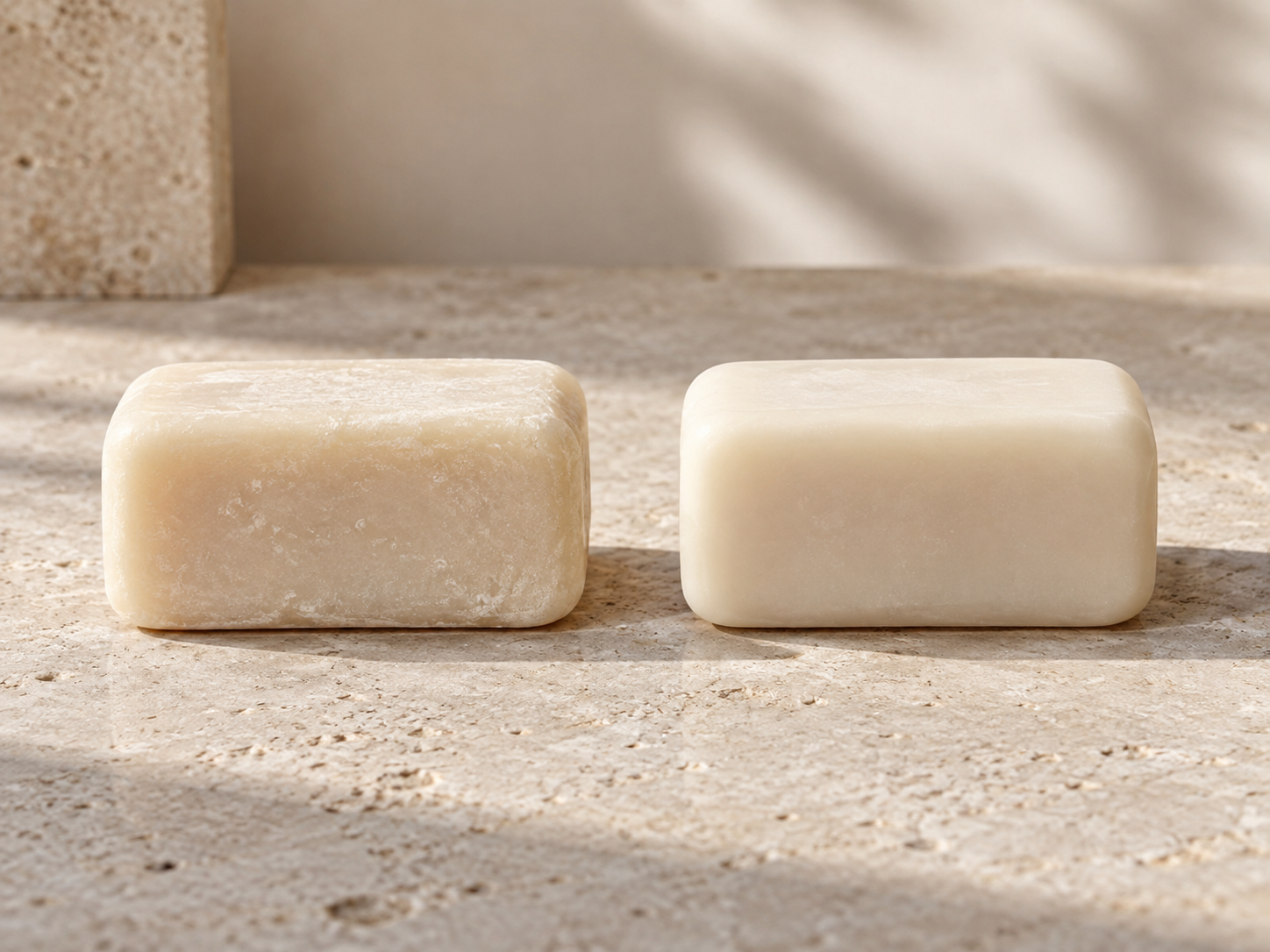
Why do shampoo bars and soap bars look so similar?
Because solid is a format, not a formulation.
Both soap-based cleansers and syndet cleansers can be made into solid bars. From the outside, there may be no obvious difference.
Shape, color, fragrance, botanical pieces or a handmade appearance do not tell you what the primary cleansing system is.
Even the words natural, botanical or shampoo bar do not answer that question.
To understand the product, you have to look inside the formulation.
What is a traditional soap bar?
Traditional soap is produced when fats or oils react with an alkali. The resulting fatty-acid salts provide the cleansing action.
Under the FDA's narrow definition of traditional soap, the cleansing action comes primarily from alkali salts of fatty acids. Cleansers that rely on synthetic detergents fall outside that narrow definition.
On an ingredient list, soap chemistry may appear through names such as:
- Sodium Cocoate
- Sodium Olivate
- Sodium Palmate
or through wording that indicates saponified oils.
These names can help identify the cleansing system, but they do not tell you whether a product will feel good or bad on your hair.
What is a syndet shampoo bar?
Syndet means synthetic detergent.
Instead of relying primarily on fatty-acid soap salts, a syndet shampoo uses other surfactants to remove oil and soils from hair and scalp.
Examples that may appear in solid shampoo formulations include:
- Sodium Cocoyl Isethionate
- Sodium Lauroyl Methyl Isethionate
- Sodium Coco-Sulfate
- other cosmetic surfactants
A shampoo may contain more than one surfactant, along with conditioning agents, structuring materials, pH adjusters and other supporting ingredients.
That is why syndet describes the cleansing system, not the complete performance of the shampoo.
Soap vs. syndet shampoo bars at a glance
| Soap-based bar | Syndet shampoo bar | |
|---|---|---|
| Primary cleansing system | Fatty-acid soap salts | Non-soap surfactants |
| Saponification | Typically yes | Not required |
| General pH tendency | Usually alkaline | Can be formulated across a wider range |
| Hard-water interaction | Soap can form less-soluble salts with calcium and magnesium | Depends on the surfactant system |
| Formula flexibility | Built around soap chemistry | Wider choice of cleansing and supporting ingredients |
| Does the category predict hair feel? | No | No |
| Does the category prove mildness? | No | No |
The important point is not that one column is automatically better.
The two systems are chemically different, but the user experiences a finished product, not a category name.
Why does pH matter for hair?
pH can influence how a cleanser interacts with the hair fiber.
Research reviewing shampoo pH and hair behavior suggests that more alkaline conditions can increase electrical charge and friction between individual hair fibers. Increased friction may contribute to roughness, tangling and mechanical stress during grooming.
But pH discussions are often reduced too far.
You may see claims such as:
pH 5.5 is good, while pH 9 is bad.
The science does not support treating one number as the complete answer.
There is no single standardized ideal shampoo pH, and the experience also depends on the cleansing system, conditioning ingredients, hair condition, water and how the product is used.
A better way to think about it is:
pH matters, but it is one part of the formulation.
What happens to soap in hard water?
Hard water contains dissolved minerals, particularly calcium and magnesium.
Fatty-acid soaps can react with these minerals and form less-soluble calcium or magnesium salts. This is the chemistry behind what is commonly called soap scum.
That is one reason a soap-based cleanser can behave differently when water hardness changes.
It does not mean that everyone using a soap-based shampoo bar in hard water will experience the same residue, lather or hair feel.
The actual result also depends on the formulation, mineral level, hair condition, washing routine and other products being used.
We explore this separately in:
Do Shampoo Bars Work in Hard Water?
How can you tell whether a shampoo bar is soap-based or syndet-based?
Start with the ingredient list rather than the appearance of the bar.
Soap-based clues
Look for fatty-acid salt names such as:
- Sodium Cocoate
- Sodium Olivate
- Sodium Palmate
or language associated with saponified oils.
Syndet clues
Look for non-soap surfactants such as:
- Sodium Cocoyl Isethionate
- Sodium Lauroyl Methyl Isethionate
- Sodium Coco-Sulfate
- other cosmetic surfactants
But do not stop after finding one familiar ingredient.
A product can contain multiple surfactants and supporting materials, and an ingredient list does not tell you concentration, processing or the entire sensory experience.
A more useful reading sequence is:
What is the cleansing system? What else supports it? What does the product as a whole actually demonstrate?
Does syndet automatically mean gentle?
No.
This is one of the most important distinctions in the shampoo-bar conversation.
Syndet tells you that the cleanser is built with non-soap surfactants. It does not automatically tell you:
- how strongly it cleans
- how it feels after rinsing
- whether it will tangle hair
- whether it will suit an oily or dry scalp
- whether it will work well in your water
Different surfactants have different characteristics, and formulators can combine them in different ways.
Conditioning materials, pH, concentration and supporting ingredients also change the experience.
So instead of asking:
Is syndet gentle?
a better question is:
How was this particular syndet shampoo formulated and evaluated?
Which type of shampoo bar should you choose?
Start with the product rather than the category slogan.
1. Identify the cleansing system
Is it mainly traditional soap, or does it use non-soap surfactants?
2. Consider your hair
Fine, oily, long, curly, chemically treated or damaged hair can respond differently to cleansing and after-wash friction.
3. Consider your water
If your water is hard, the interaction between the cleanser and dissolved minerals may become more relevant.
4. Look beyond the hero ingredient
A botanical name or fashionable surfactant does not explain the entire formulation.
5. Pay attention to repeated use
One wash can tell you whether something foams.
Repeated use tells you more about rinsing, residue, dryness, tangling and manageability.
A shampoo bar is best judged as a formulation, not as a shape or a single ingredient.
How Bare Sway approaches solid shampoo
Bare Sway separates three questions:
What is the format?
A solid bar.
What is the cleansing system?
The surfactants and supporting materials used to clean.
How does the finished shampoo behave?
That depends on the complete formulation and appropriate evaluation.
Our current hair-development work is exploring a modern solid shampoo / syndet direction. Ingredient choices, final formula details and product-specific performance language will follow the finished product and the evidence supporting it.
Frequently asked questions
Is a shampoo bar the same as a soap bar?
Not necessarily. A shampoo bar is a solid hair-cleansing format. It can be built with traditional soap chemistry or with non-soap surfactants.
Can a shampoo bar be soap-based?
Yes. Some solid hair cleansers use fatty-acid soap salts, while others use syndet systems.
What does syndet mean?
Syndet is short for synthetic detergent. It refers to cleansing surfactants other than traditional fatty-acid soap salts.
Is a syndet bar still a shampoo bar?
Yes. If the product is formulated and intended for hair cleansing, it can be a shampoo bar. Bar describes the format; syndet describes the cleansing system.
Are syndet shampoo bars automatically gentler than soap?
No. Surfactant blend, concentration, pH, conditioning system and the rest of the formulation all affect the finished experience.
Are syndet shampoo bars always pH-balanced?
No. The word syndet does not tell you the exact pH of a finished shampoo.
Why can soap behave differently in hard water?
Calcium and magnesium in hard water can react with fatty-acid soaps and form less-soluble salts.
Can I wash my hair with a regular soap bar?
Soap can remove oil and soils, but cleansing ability and suitability for hair are not the same question. If you experience repeated roughness, tangling or difficult rinsing, the cleansing system and water conditions are worth considering.
Sources & further reading
- U.S. FDA — Frequently Asked Questions on Soap
- Dias et al. (2014) — The Shampoo pH can Affect the Hair: Myth or Reality?
- D’Souza & Rathi (2015) — Shampoo and Conditioners: What a Dermatologist Should Know?
- Takada et al. (2023) — Effect of Water Hardness on Acute Aquatic Toxicity of Fatty Acid Salts